
Freestanding vs. Wall Mount Umbrella: What to Pick?


Freestanding vs. Wall Mount Umbrella: What to Pick?
Table Of Contents
Outdoor areas play a central role in driving revenue for restaurants, resorts, and event venues. Whether it's a shaded patio for dining, a poolside lounge, or an open-air event courtyard, providing comfortable, functional shade directly impacts the guest experience.
The type of commercial umbrella selected doesn't just affect aesthetics; it influences traffic flow, furniture layout, and overall service efficiency. Choosing between a wall mount umbrella and a freestanding cantilever umbrella requires understanding how each one functions in a commercial setting.
This guide compares the two styles to help you determine which option best suits your space and operational needs.
Overview of Wall Mount Umbrella and Freestanding Offset Umbrellas
- Wall Mount Umbrella
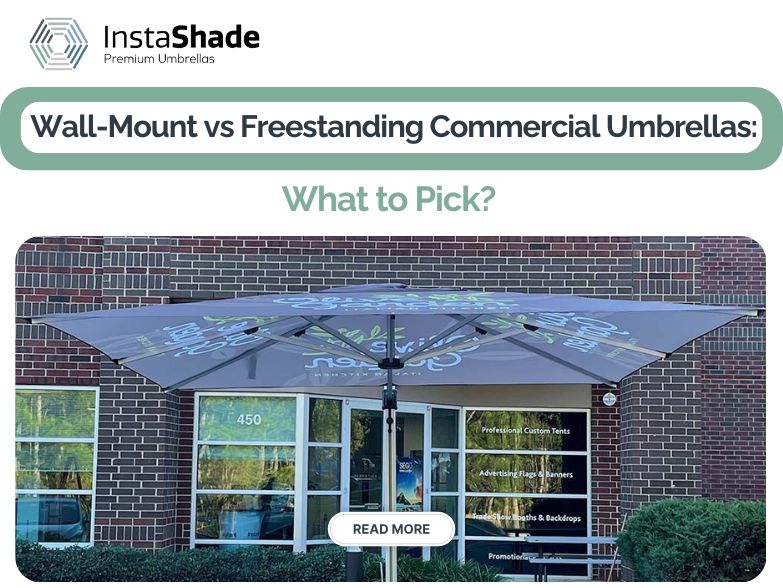
A wall mount umbrella is attached directly to vertical surfaces, such as building facades or walls. They’re often fixed in place but may feature adjustable arms or rotating brackets to extend shade coverage. This type is well-suited for narrow patios or tight urban environments where floor space is limited and walkways need to remain clear.
- Freestanding Offset Umbrellas
Freestanding umbrellas operate independently, supported by fixed or weighted bases and a side-post structure. These umbrellas offer greater flexibility (except the one with fixed bases) in terms of portability and positioning. Unlike wall-mounted ones, they don’t need a wall or building facades to get installed and are ideal for open seating areas, poolside zones, and event spaces that require adaptable layouts.
Comparison Factors for Wall Mount Umbrella and Freestanding Offset Umbrella Applications
Now, to help you decide which option, a wall-mounted or freestanding cantilever (offset) umbrella, might be more suitable, here are some key comparison factors to consider. These include space and layout flexibility, guest comfort and coverage, wind resistance and durability, installation and infrastructure requirements, as well as visual impact and branding opportunities. Let’s take a closer look at how each type of umbrella performs across these areas:
Space & Layout Flexibility
-
Wall-Mount Umbrella: An effective solution for tight or fixed spaces, especially where tables are set against a wall or along high-traffic walkways with limited room for repositioning. Ideal for restaurant outdoor areas located on the street or small patios.
-
Freestanding Cantilever Umbrella: Supports modular seating arrangements, making it easier to reconfigure layouts across terraces, pool decks, or event spaces. It’s most suitable for low-traffic areas like restaurant patios or poolside settings where foot traffic is generally limited to customers only, or large home patios, gardens, and backyards where there is ample space for maneuvering and good flexibility for repositioning based on the homeowner’s frequently changing preferences.
Guest Comfort & Coverage
-
Freestanding offset Umbrella: Typically offers broader coverage and can be repositioned to follow the sun or suit different seating plans at different events, providing shade to guests throughout the day.
For example, the Instashade Cantilever umbrella with 45-degree tilt and 360-degree rotation provides shade from the sun and its harmful effects, as it uses UV-resistant fabric for its canopy.
-
Wall Mount Umbrella: Provides targeted shade without occupying floor space, making maneuvering for guests convenient and allowing different table arrangements underneath. This makes it useful for smaller patios or narrow outdoor corridors.
Wind Resistance & Durability
-
Wall-Mount Umbrella: Anchored directly into walls or structures, offering a stable solution for sheltered or semi-sheltered areas. One key advantage is that it remains protected from wind thanks to the wall or building structure, which acts as a barrier. As a result, it doesn't have to endure the full force of strong winds on windy days.
-
Freestanding Offset Umbrella: May require heavy-duty supports such as in-ground mounts, concrete-filled weighted bases, or ground anchors to stay secure in open, wind-exposed environments. Since these umbrellas stand alone in open spaces, they must be able to handle high wind conditions, something they’re built for, using highly durable materials.
For instance, in Instashade freestanding cantilever umbrellas, anodized aluminum is used in the frame construction, helping them withstand wind speeds of up to 35 mph.
Installation & Infrastructure Needs
-
Wall Mount Umbrella: Requires a structurally sound wall or durable surface for stable and secure installation. Not suitable for lightweight or temporary walls, as installing on them may lead to accidental damage.
-
Freestanding cantilever Umbrella: Easier to deploy, often self-installing when paired with a weighted base, but professional assistance is recommended for more permanent setups, such as in-ground mounts or ground mount plates. It also requires adequate floor space and potentially greater clearance to accommodate the base and the movement of the canopy arms.
For more details on ensuring long-term stability and safety, read our insightful guide on Choosing the Right Cantilever Umbrella Base for Stability and Safety.
Visual Impact & Branding Opportunities
-
Freestanding offset Umbrella: Freestanding umbrellas provide significantly more surface area for custom branding, whether it’s a logo, tagline, or full-color graphics. Their prominent placement and full canopy coverage make them an excellent choice for businesses looking to enhance brand visibility in outdoor settings. From sidewalk cafés and poolside lounges to promotional events and pop-up activations, freestanding models double as eye-catching signage that reinforces your visual identity with every glance, thanks to their portability option.
-
Wall Mount Umbrella: Wall-mounted umbrellas offer a more subtle, streamlined appearance that blends seamlessly with the surrounding architecture. While they are less dominant visually, they can still support minimal branding or color-matching to maintain brand consistency. However, due to their smaller canopy size and fixed positioning, they offer limited space for impactful graphics or bold design elements.
Use Case Breakdown for Wall Mount and Freestanding Offset Umbrella: What Works Where
|
Venue Type |
lBest Option |
Reason |
|
Restaurant Patio |
Wall-Mount or Small Freestanding |
Depends on available wall space and foot traffic layout |
|
Resort Poolside |
Freestanding Cantilever Umbrella |
Allows flexible shade placement and guest comfort |
|
Event Courtyard |
Freestanding Cantilever Umbrella |
Accommodates changing layouts and multi-use setups |
|
Rooftop Dining |
Wall-Mount (If structural) or Low-Profile Freestanding |
Preserves skyline views while providing shade |
Key Questions to Guide Your Decision on an Outdoor Umbrella with Different Mounting Options
-
Is the space permanent or modular?
-
Are there existing walls or structural supports available?
-
How important is visual branding or umbrella visibility?
-
What wind and weather conditions does the area face?
-
Will the umbrellas be used seasonally or year-round?
Once you’ve answered these questions, the comparison of mounting types based on key factors will help you make a clear and confident decision.
Conclusion: Functional Shade That Matches Your Business Goals
Wall-mount umbrellas are best suited for compact, fixed layouts where space-saving is essential. Freestanding cantilever umbrellas, on the other hand, offer more versatility and visual presence, making them ideal for larger, adaptable environments.
Ultimately, the right choice depends on your space, infrastructure, and operational goals. A tailored solution, whether wall-mounted or freestanding, can enhance traffic flow, elevate guest comfort, and support long-term performance.
If you’ve decided that a freestanding cantilever umbrella is the right fit, don’t wait; visit InstaShade to explore the collection of premium commercial-grade freestanding umbrellas, built to deliver reliable performance and visual appeal in a variety of weather conditions.
FAQs on Freestanding vs. Wall Mount Umbrella: What to Pick?
Can a freestanding cantilever umbrella be used in high-wind areas?
▶Yes, but it must be properly secured using a heavy-duty base, in-ground mount, or ground anchor system. Some commercial-grade freestanding umbrellas, like those with anodized aluminum frames, are designed to withstand wind speeds up to 35 mph. For areas prone to stronger gusts, a wall-mounted umbrella sheltered by a building might be a safer choice.
Is a wall mount umbrella suitable for all commercial buildings?
▶Not necessarily. Wall-mounted umbrellas require a structurally sound, permanent surface for installation. Lightweight facades, temporary partitions, or older brickwork may not provide adequate support and could be damaged during installation. Always assess the integrity of the wall before choosing this option.
Which umbrella style offers more branding opportunities?
▶Freestanding cantilever umbrellas offer more visible surface area and placement flexibility, making them ideal for bold custom branding. Wall-mounted umbrellas are more discreet, with smaller canopies and limited visibility, which restricts the impact of logos or full-colour prints.
Can I use both wall mount and freestanding umbrellas in the same venue?
▶Absolutely. Many restaurants, resorts, and event spaces use a hybrid approach, wall mounts for space-restricted areas like narrow walkways, and freestanding umbrellas for open seating zones or pool decks. This ensures functional coverage without compromising layout or traffic flow.
Need more advice? InstaShade’s experts are here to help!